
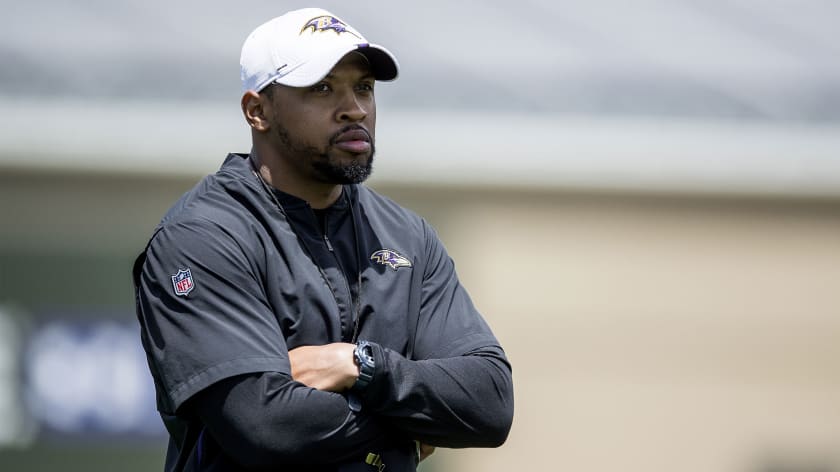
The Baltimore Ravens special teams portion of practice had a different look to it from previous years when the team took the field for OTAs (Organized Team Activities) recently. That’s because a rule change to the kickoff process was adopted at the NFL’s Annual League Meeting in March. Team owners officially voted to approve a new kickoff format, adopting a system that was first seen in the XFL.
“You know, it’s something new to our league,” said Ravens special teams coach Chris Horton last week. “And I’ve talked to the players about this – we’re going to build this thing together because we don’t really know what it’s going to look like. We’ve seen video from the XFL, and we understand what that looks like. But we actually have to get out here, and we have to practice it ourselves to kind of see what those angles look like and see what we can run and what we can’t run.”
So, what is this new rule?
Per the NFL, the new format will still see the ball kicked from the kicking team’s 35-yard line, but every player on the kicking team other than the kicker will now line up with at least one foot on the returning team’s 40-yard line. At least nine members of the returning team will line up in a “setup zone” beginning five yards opposite on its own 35-yard line (a minimum of seven players must have a foot on what is known as the “restraining line”) stretching to its own 30-yard line, with up to two returners in the “landing zone” (defined as the zone between the goal line and the 20-yard line).
No players other than the kicker and the returners can move until the ball is fielded by a returner.
Any kick that is caught or lands in the landing zone must be returned, while any kick that falls short of the landing zone will be ruled a touchback and spotted at the returning team’s 40-yard line.
If a kick hits the landing zone and then goes into the end zone, it has to be returned or downed by the receiving team. If it’s downed, it will be ruled a touchback and go to the 20-yard line.
If the ball hits the end zone and stays inbounds, it has to be returned or downed – if it’s downed, it is a touchback and moved to the 30-yard line. Similarly, if the ball goes through and out of the end zone, it will be a touchback to the 30-yard line.
Horton feels the new rules allow them to get more reps during practice because it doesn’t require players to run as far to get to the returner. Previous rules had kickoff coverage units run from their 35-yard line. Now they’re only running 20 – 25 yards before contact.
“We just have to adjust, and we have to adapt to whatever the standards are and whatever the rules are going to be because I know our guys feel pretty good about it. Man, we get to cover kicks. We get to return the ball again. Those are some things that were lost over the last couple of years,” Horton added.
The change in rules could alter some of the backend roster spots as the personnel would like shifts to begin more geared towards players which can impact the kickoff coverage and return of the units.
Everything is a feeling-out process now. Horton is trying different things with various player groupings as they work to find the right mix and allow players to get a feel for the changes. Schemes will evolve as the units get more familiar with the changes.
It’s an ongoing adjustment, but one that Horton embraces.
“I am fired up,” Horton said. “I told these guys as I was walking up, if you don’t adapt, you die.”