
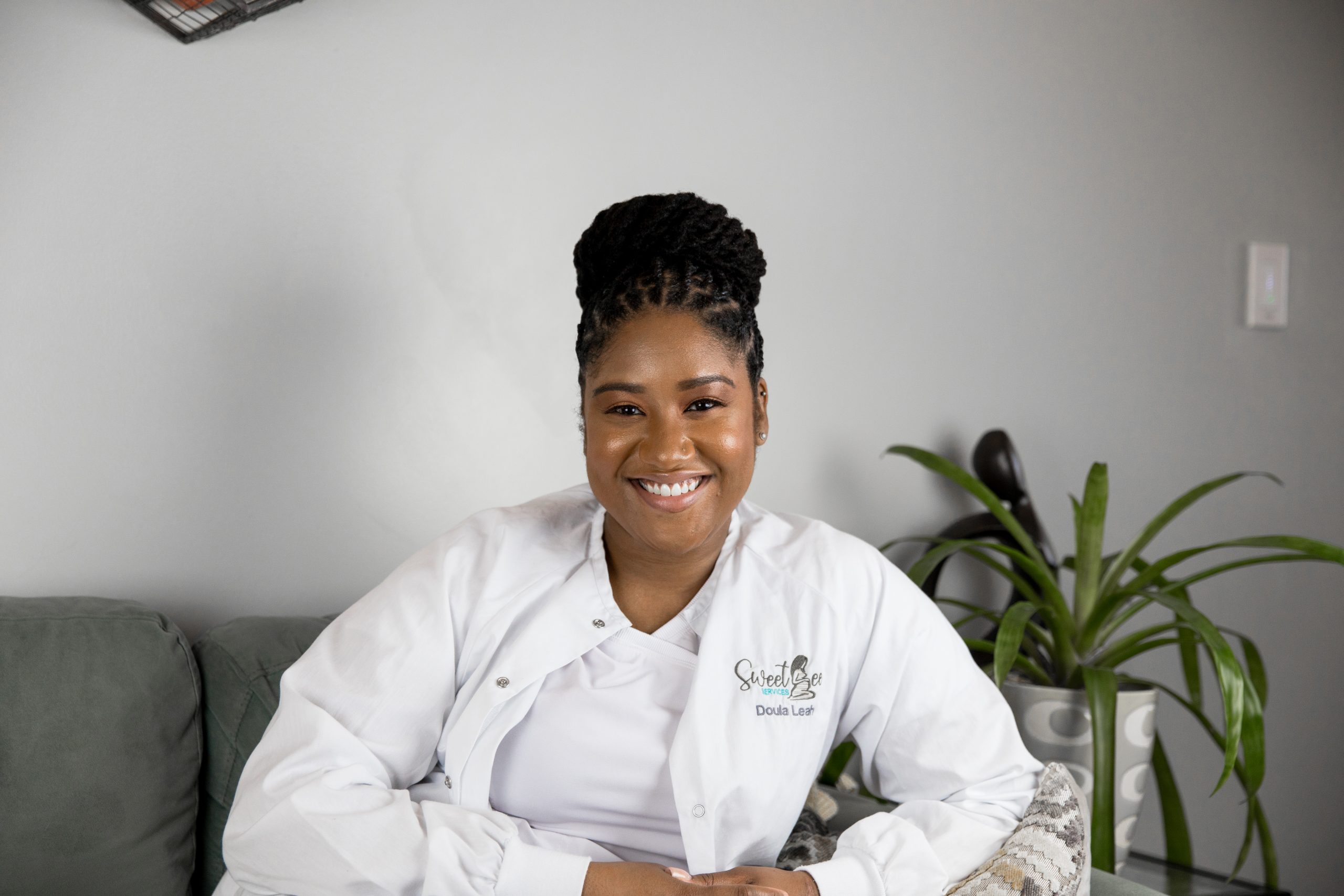
Leah Hairston, a Baltimorean and founder of Sweet Bee Services, once pretended to feed a cabbage patch doll named Sonya when her mother fed her siblings. Her nurturing spirit increased and deepened. Hairston became interested in the doula profession when she was a middle school student. She recalls watching “A Birth Story” on TLC, but Black doulas were missing from birth stories she watched. After pursuing college at Howard University, and graduate school at Columbia University School of Social Work, Hairston answered the call to become a doula and launch a full-spectrum doula agency.

Photo credit: Sarah Elizabeth
What is a doula?
Black doulas are rare, but they do exist. It has been reported that 10 percent of doulas in the nation are Black.
“The doula is a professional trained in childbirth who provides emotional, physical, and educational support to a mother who is expecting, is experiencing labor, or has recently given birth. Their purpose is to help women have a safe, memorable, and empowering birthing experience,” according to the American Pregnancy Association.
Hairston primarily operates her business in Maryland, DC, and Virginia. However, Sweet Bee Services has clients in eight different states. Childbirth education classes, lactation counselors, a registered dietician, a pelvic floor physical therapist, massage therapists and yoga instructors can be accessed through her business, in addition to doulas who can provide virtual and in-person support.
“We have a team of doulas who are certified birth and certified postpartum doulas,” Hairston said. “At Sweet Bee Services, we attend to both home birth and hospital births, as well as birth centers and anything in between.”
She explained how she worked to provide virtual support for out-of-state clients. After a due date was confirmed, she traveled to help them induce their labor naturally. Hairston worked with their midwives and doctors. After they gave birth, she stayed longer to provide postpartum support.
Why do some people use doulas?
The CDC reported that “Racial disparities persist. The risk of pregnancy-related deaths for black women is three to four times higher than those of white women.”
Doula care is not just for wealthy families or women of a certain ethnicity. Hairston stated that her company serves everyone. However, Sweet Bee Services started because of this sobering statistic.
She further explained, “Research has also shown that the first year after having a baby is the most dangerous for people, in terms of maternal mortality rates, so our clients look like everyone under the sun.”
How do doulas help address Black womens’ health outcomes?
Hairston said that one of the main statistical reasons that mothers are dying is because advocacy for their health is needed either during or shortly after childbirth. For example, if mothers are experiencing hemorrhaging or excessive bleeding, or if they have concerns connected to hypertensive disorders, their medical records may not have been fully understood by the providers to enable continuity of care to be given. Also, racialized perceptions around health care needs, and the stereotypical perception that Black people do not experience pain in the same manner as others, can become a factor.
When people do not feel comfortable speaking up because of power dynamics, they do always receive the care that they need immediately.
“And so, there’s a prolonged path before they actually receive necessary interventions,” Hairston explained.
As a doula, she helps her clients from the very beginning through the childbirth education class. Hairston supports them in maintaining a sense of control and power.
What is the difference between a doula and a midwife?
Hairston stated that midwives are clinically trained healthcare providers. Doulas are not.
“Midwives’ jobs are to make sure that physically, people are safe during their pregnancy and during postpartum, as well as their birth experience.”
She added, “I explain it this way. Doctors are there when people are pushing. Nurses are typically there towards the end of the labor experience, or throughout labor and when they’re pushing. Doulas are there from the time people become pregnant, up until their babies are about a year old, depending on what support they need and the depth of the relationship that we’ve built together.”
A Rewarding Impact
Doulas like Hairston coach, teach, provide information, decrease the risk of traumatic experiences, and advocate with compassion.
“Everyone needs a doula like you! What you do is literally life-saving! We are so grateful for the information, emotional support, and care you gave our family,” said Davida McPhee, wife of retired Baltimore Ravens player, Pernell McPhee.
Visit https://www.sweetbeedoula.com to learn more about Hairston and Sweet Bee Services.