
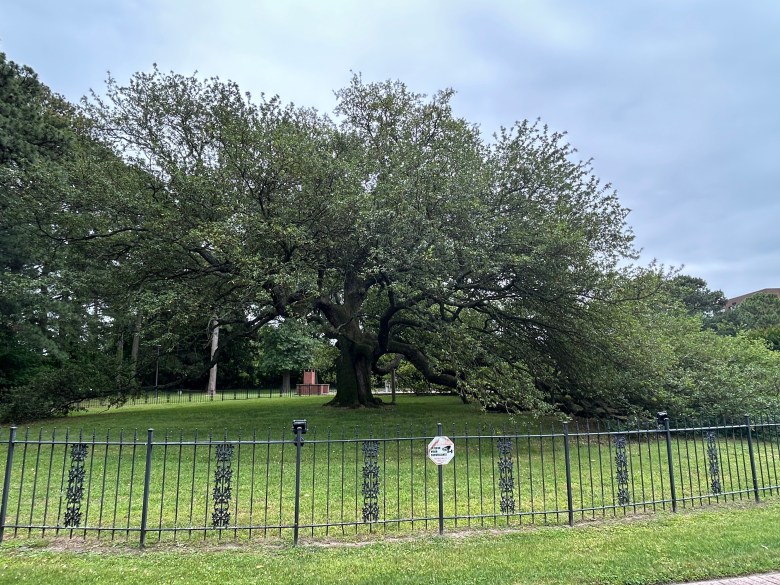
If the Emancipation Oak could talk, it would surely have stories to tell about the promise of education and a woman who broke the law to teach classes to hungry minds of all ages. The sprawling tree is located on the grounds of Hampton University, an HBCU located in Hampton, Virginia. The Emancipation Oak is believed to be more than 200 years old, but that is not the most impressive aspect of the majestic tree.
The historic oak tree’s storied history begins with Mary Smith Peake (1823-1862), a humanitarian and the first Black teacher hired by the American Missionary Association, who bravely taught “contrabands” to read and write in 1861 under the limbs of a live oak tree near in what is now the community of Phoebus, according to National Park Service (https://www.nps.gov/people/mary-smith-peake.htm). Peake refused to accept a salary for her work, according to the Library of Virginia (https://old.lva.virginia.gov/public/dvb/bio.asp?b=Peake_Mary). She dedicated her life to teaching the less fortunate who wanted a better life.
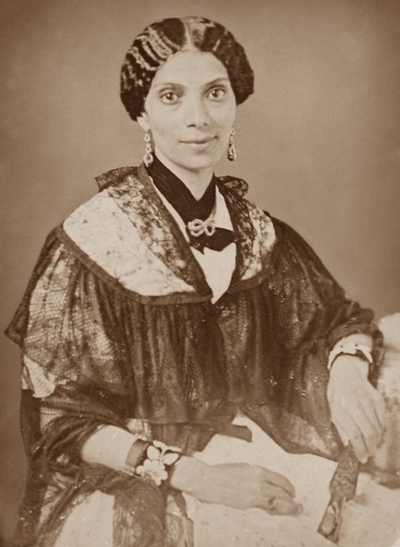
Photo: Hampton University Museum Archives
“The American Civil War had shortly begun and the Union Army held control of Fort Monroe in Hampton, Virginia at the mouth of the Chesapeake Bay. In May of that year, Union Major General Benjamin Butler decreed that any escaping slaves reaching Union lines would be considered “contraband of war” and would not be returned to bondage. This resulted in waves of enslaved people rushing to the fort in search of freedom,” Hampton University reported (https://home.hamptonu.edu/about/history).
“The Grand Contraband Camp” housed newly freed slaves. The camp was built several miles outside of Fort Monroe’s protective walls.
“It functioned as the United States’ first self-contained African American community,” according to Hampton University.
Although Peake had been born free in Norfolk, Virginia to a free Black woman and an Englishman, Peake cared about formerly enslaved people who could not legally receive education. American Battlefield Trust (https://www.battlefields.org/visit/heritage-sites/mary-peake) noted that as a young girl, Peake attended a school for Black children in Washington, D.C. (currently present-day Alexandria).
She began to secretly teach enslaved and free African Americans to read and write in her teenage years, although it was illegal because of a 1831 Virginia law that followed Nat Turner’s rebellion. At that time, various states passed laws to prohibit free and enslaved Black people from learning to read or write.
Peake moved to Hampton with her family, where it was illegal for free Black people to meet for purposes of obtaining an education. She worked as a successful seamstress to support herself and was regarded as a member of the Black elite. Peake bravely held her first class on September 17, 1861 under what is now known as The Emancipation Oak. She is regarded as the “First Teacher of the Freedmen at Fortress Monroe, Va.”
“Enrollment grew from six to more than fifty students, including her daughter, in a matter of days, and the school soon occupied a house near the Chesapeake Female Seminary. Classes met on the first floor, and the Peakes lived on the second floor,” the Library of Virginia stated (https://old.lva.virginia.gov/public/dvb/bio.asp?b=Peake_Mary).
The Emancipation Oak later became the site of the first Southern reading of the Emancipation Proclamation in 1863.
“Just five years later, the American Missionary Association founded what would become Hampton University on the site of Peake’s outdoor classroom,” according to the National Park Service (https://www.nps.gov/people/mary-smith-peake.htm).
“Freed people, soldiers, and missionaries continued her mission. This site near the oak became the Butler School in 1863 and, after the war, became part of Hampton Normal and Agricultural Institute – the predecessor of Hampton University,” American Battlefield Trust added.
The Library of Virginia noted that even when Peake collapsed in the latter years of 1861 due to poor health, she insisted on teaching from her bed until she drew her final breath. She died on the night of 22 February 1862 from tuberculosis. Peake made an impact even after her demise.
“General Butler founded the Butler School for Negro children, where students were taught reading, writing, arithmetic, geography, and grammar, as well as various housekeeping skills,” according to Hampton University.
It was further noted that in 1863, government funds were used to continue the foundational work initiated by Peake.