
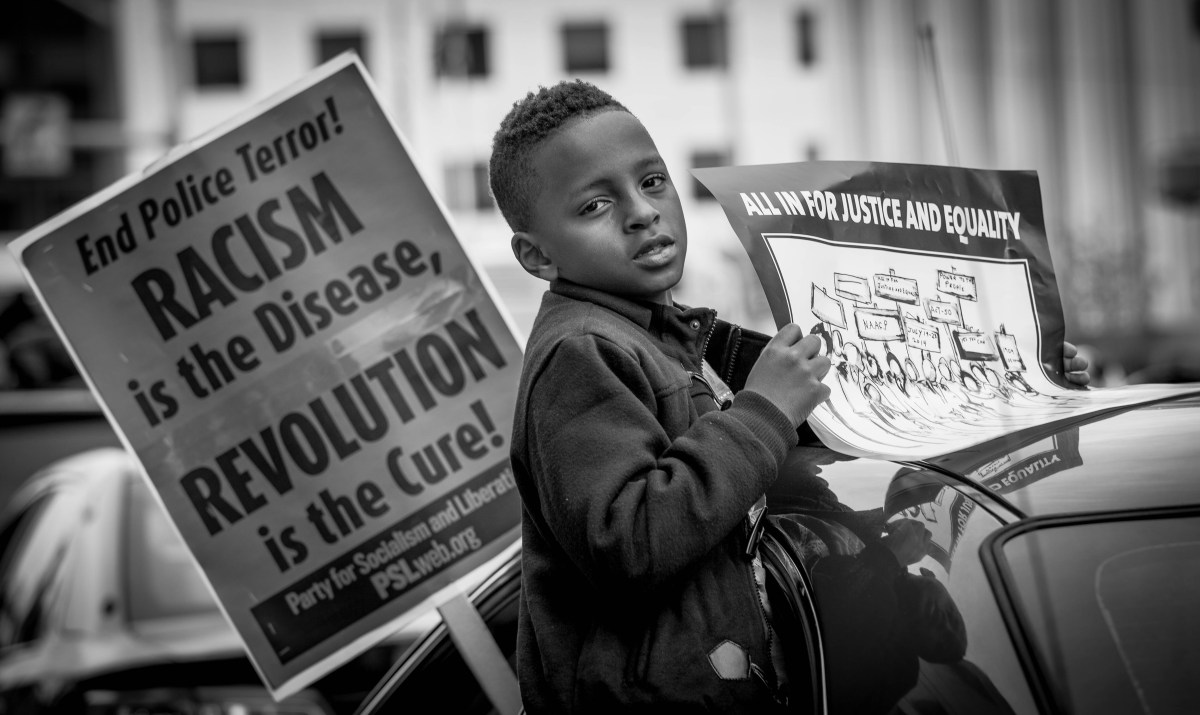
In his book, Across That Bridge: Life Lessons and a Vision for Change, John Lewis shares,
“Ours is not the struggle of one day, one week, or one year. Ours is not the struggle of one judicial appointment or presidential term. Ours is the struggle of a lifetime, or maybe even many lifetimes, and each one of us in every generation must do our part.”
I was reminded at the Challenge 2 Change Gala at the beginning of this month that many of today’s violence interruption organizations, responsible for the historic drop in violent crime, will celebrate their 10th anniversary this year. Organizations born not only out of the 2015 Uprising, but out of grief, determination, and the belief that the people closest to the problems are also closest to the solutions.
The April 2015 uprising was more than a moment of unrest; it was a communal outcry born from decades of systemic neglect. Groups that had been informal became formal; those already established found new urgency, and, in some cases, new resources.
VP of Baltimore Brothers, Bilal Rahman, described beginnings that were less strategic than responsive, an encounter with unmet need in neighborhoods where structured support had receded.
“Baltimore Brothers, before we actually got our legal footings. It started in the aftermath of the Freddie Gray uprising…when Baltimore Brothers started, we just started seeing a lot of young people that needed help and service. There weren’t a lot of recreations open at that time.”
Elijah Miles recalls a different catalyst: disillusionment. The national gaze, once fixed on Baltimore, proved fleeting. The anticipated transformation did not materialize. What remained was the city itself and the people in it tasked with the slower, less visible labor of continuity.
“Tendea Family, is a grassroots organization started in 2015 and the aftermath of the Freddie Gray uprising, and I would say we wasn’t founded on police brutality. We were still all on Morgan State campus… what we seen in the Freddie Gray moment and in the uprising was that all of the cameras from around the country came down to little ole Baltimore City. All of the civil rights leaders from around the country were rushing to Baltimore City to get in front of marches and get in front of cameras. I thought that things were going to radically shift, especially in like Penn, North or West Baltimore, where the epicenter was but Tendea was started kind of because of the disappointment of how it played out afterwards, that after the cameras went away, after the Civil Rights leaders went away, things kind of went right back to normal.” – Elijah Miles (Chairman, Tendea Family, Baltimore Legacy Project Interview)
For Anthony W. Muhammad, the founding of We Our Us emerged from a recognition of absence: a gap between the intensity of the moment and the infrastructure required to sustain change.
“The We Our Us organization began around 2015 right after the Freddie Gray uprisings. A lot of the community leaders and activists who were involved in kind of quelling that storm decided that there was a need or void in the community to kind of address a lot of the concerns that emerged that kind of produced that atmosphere, that environment. So two individuals by the name of Andrew Muhammad and Dr Andrey Bundley at the time, were working for the Mayor’s Office of African American Male engagement, decided that they needed something a little more specific in terms of community engagement, and created an organization called “We Our Us”” –Anthony W. Muahmmad (We Our Us)
Even the creation of the Baltimore Children and Youth Fund; a voter-backed commitment to invest directly in youth, reflects this longer horizon. Its design was shaped by a departure from familiar patterns, favoring direct investment in Black-led organizations over more diffuse grantmaking traditions. Policy, here, becomes another site where the decade asserts itself over the moment.
Anniversaries arrive not simply as commemorations but as checkpoints; occasions to measure what has endured, what has shifted, and what remains unresolved. April, in Baltimore, carries this dual weight: memory and mandate. Let this April be a powerful reminder that Baltimore’s neighborhoods are not defined by their challenges but by the people who rise each day to remake them.
Dr. s. Rasheem
Dr. s. Rasheem is an Independent Scholar and Social Scientist whose scholarship encourages a critical examination of society and culture through the lens of race, gender, and class. Her educational background is interdisciplinary, and includes a Bachelors degree in Social Science, a minor in Sociology, a Masters’ in Nonprofit Management and a Doctorate of Philosophy in Social Work. She has been a Principal Investigator on at least five different qualitative research initiatives and has spoken on the topic of equity at over 30 academic and professional conferences.
The Baltimore Legacy Column is dedicated to uncovering and preserving the cultural memory of Baltimore through connecting the stories, reflections, and experiences of residents who witnessed and shaped the city’s evolution to the city's historical records. Ultimately, the Baltimore Legacy Column serves as a foundation to inform, inspire, and guide future generations of leaders in Baltimore City.