
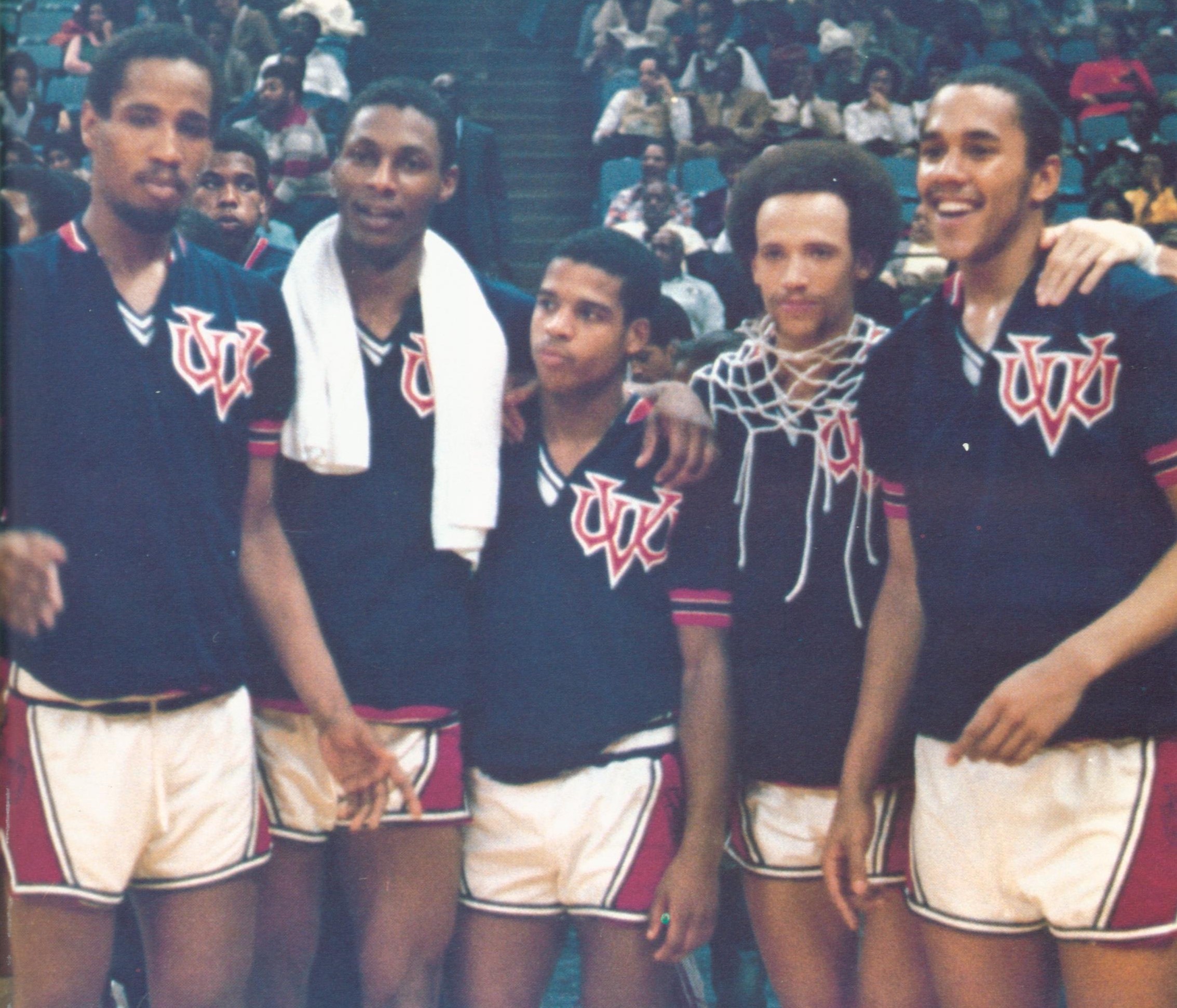
Former Walbrook High/Virginia Union University basketball star Derwin Lilly may have only been 5’8”, but to many of the players he played with and against in high school and city youth basketball leagues like Project Survival in the mid-1970s, he stood tall.
“He was a great player, a great point guard,” said Dewayne “Hot Dog” Wallace, who played high school basketball at Dunbar and his college basketball at the University of Pittsburgh. “He was able to see the court, the whole court. He was a great student of the game. If he was 6-3, 6-4, he would have made it to the (NBA).”
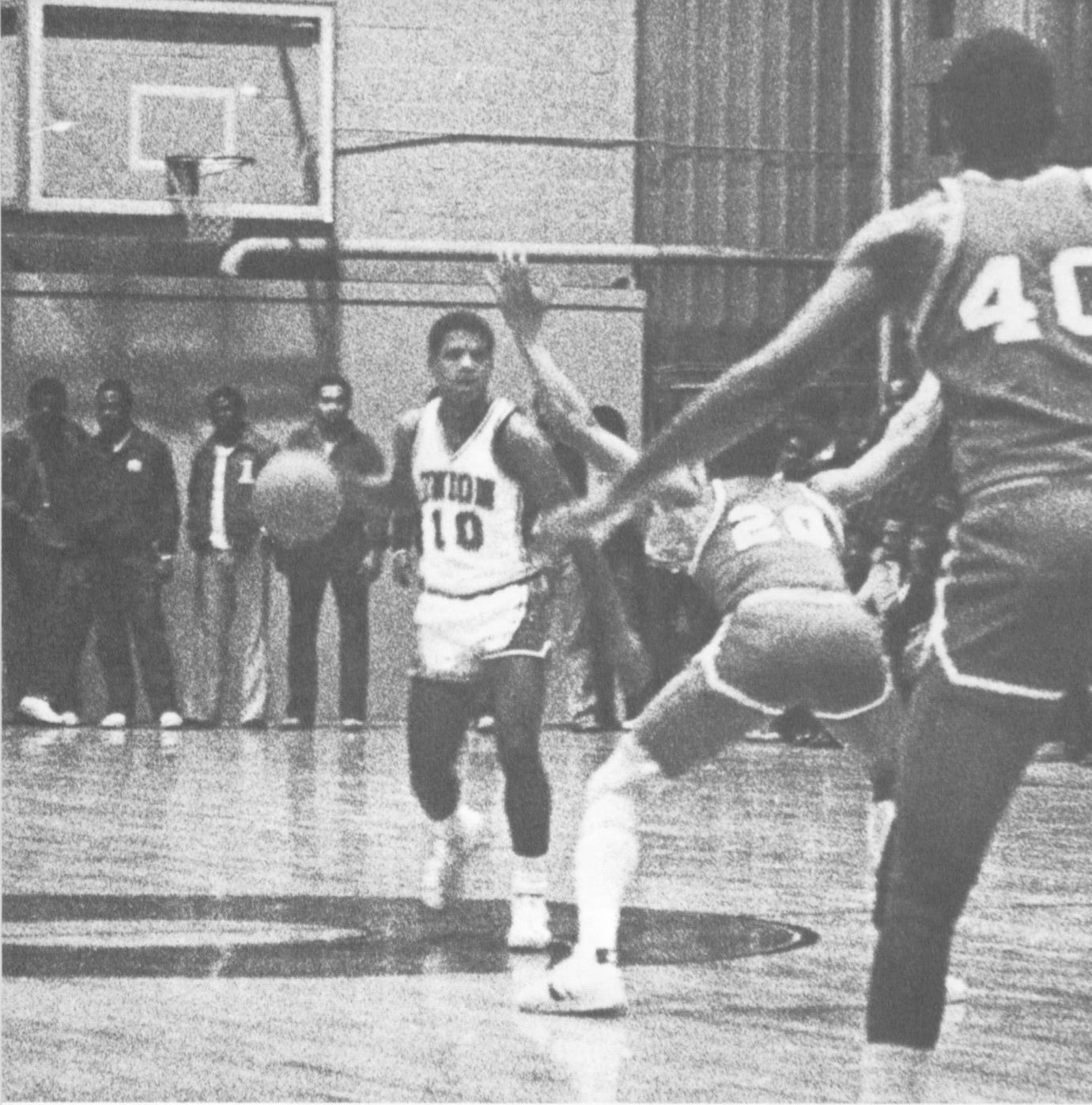
Photo courtesy Virginia Union University Archives and Special Collections.
Lilly, a native of West Baltimore, honed his skills in youth basketball leagues like the Baltimore Neighborhood League and Project Survival, which focused on both basketball and education. Everyone who saw him play was impressed by him, Wallace said.
Former Dunbar assistant coach, Kevin Parson, said Lilly was outstanding on both ends of the court.
“A lot of people don’t give him credit for his defensive skills,” Parson said. “He was able to create turnovers, if not steal the ball, and then start the (fast break).”
While playing basketball at East Baltimore’s legendary “Madison Dome” in 1973, Lilly caught the eye of Madison 15 and under coach Henry “Sarge” Powell, who was astounded by the way the diminutive point guard dribbled through his full-court press.
“We had a diamond and one press where we attacked the point guard and tried to force [him] to one side or the other and trap him with the ball,” said Powell, who coached future NBA stars Carmelo Anthony and Sam Cassell. “But [Lilly] was very smart and he had a lot of court awareness. He beat our press by dribbling through it and that impressed me an awful lot. … I kept saying to myself ‘who in the hell is this guy handling the ball like this?’”
Powell was so enamored with Lilly’s ball-handling skills that he offered him a chance to play for his squad. While he didn’t want to join at first, Flash Gordon, his longtime mentor and coach at the Lafayette Recreation Center, convinced him to do so.
“Flash said ‘naw, son you need to come up to a different level’ and that’s how I ended up playing for Madison 15 and under. … We won the whole city-wide BNBL championship (in 1973),” Lilly said.
Reflecting on his youth, high school, and collegiate basketball days, Lilly said he never allowed his height to hinder his ability.
“As far as growing up, I always played older, so my size and height never was a factor,” Lilly said. “Flash taught me the fundamentals. I worked hard on my game. Because of my handle, I was able to get any on the court I wanted to, but I just worked hard on my game, and I never took shortcuts.”
Lilly made the Baltimore Sun’s All-Met team in both 1975 and 1976 during his days at Walbrook High School in West Baltimore and opted to attend Virginia Union University, a CIAA Division II school in Richmond, despite getting interest from other schools.
The competition in the CIAA and the MEAC (Mideast Athletic Conference) was fierce, Lilly said.
“When I got to go down there and visit, the arenas used to be packed,” he said. “You had to bring it. It was show time. Basketball in the CIAA and the MEAC (Mideast Athletic Conference) was tough.”
At Virginia Union, Lilly was a starter and an All-CIAA guard all four years. He also took the Panthers to two CIAA championships and two trips to the NCAA Division II Tournament.
After his freshman season, Lilly was selected to be on a CIAA All-Star team that toured Africa. In his senior season, he scored 376 points and averaged 12.5 points a game to lead Virginia Union to a national title.
“[Lilly] was a coach on the floor,” said former Virginia Union head coach Dave Robbins, who led the Panthers to that championship in 1980. “He rarely turned [the basketball] over. He did everything I asked as far as running the team. If he didn’t play well, we wouldn’t have won the national championship.”
Added Parson: “One of the things about the (Virginia Union) team he played on is that they had a lot of quickness and [Lilly] added to that as a point guard.”
Lilly’s performance as an undersized point guard at Virginia Union opened the door for similar guards and led Robbins to recruit Muggsy Bogues, who went on to have an outstanding college career at Wake Forest before heading to the NBA.
When he returned to Baltimore following the championship season, Lilly was lauded by his friends, fellow CIAA alumni players and his fellow former city league players for his success. It was a shared victory, he said.
“They knew how tough it was just to win a CIAA championship because before we used to talk about it,” Lilly remembered. “Everyone knew the journey that you had to go through.”
Although Lilly didn’t turn pro, his work ethic took him far. After his college basketball days ended, Lilly got his degree in accounting from Virginia Union and worked as an accountant at the National Aquarium in Baltimore and as an auditor for the Maryland Department of Education.
He and his wife Ella have two children, four grandchildren and one great-grandchild. One of his grandchildren, Samuel Scott, is a redshirt freshman on Virginia Union’s basketball team.
For Lilly, the triumph is that he and his siblings — two sisters and three brothers — earned their college degrees. His mother, Dorothy, instilled the importance of getting an education in all of her children and made it happen even after her husband James died when Lilly was 14.
“My mother and father never graduated but they were hard on us …It was about education, education, education,” Lilly said. “Education is so important because everybody ain’t going pro, so you’ve got to get the most out of this.”