

On Tuesday, June 4, 2024, citizens joined community leaders and Baltimore Mayor Brandon Scott at the Center Club in downtown Baltimore, as Tim Berry, Global Head of Corporate Responsibility at JPMorgan Chase, unveiled the latest in the firm’s overtures towards under-invested communities in the Black and Latino community.
The announcement at The Center Club is the latest in the global financial services firm’s $20 million, five-year plan to drive inclusive economic growth across underserved communities in Baltimore.
Tim Berry announced an $8.45 million investment in the city’s small businesses and affordable housing initiatives.
“We are thrilled to grow our commitment in the great city of Baltimore with new funding to help strengthen the community through homeownership, commercial corridor revitalization, and small business growth,” Berry said.
The $8.45 million investment will be split between two core focus areas:
Housing & Neighborhood Revitalization ($6 million)
This allocation will stabilize the housing supply and increase affordable homeownership opportunities by funding nonprofits engaged in neighborhood stabilization, wealth-building for underserved communities, and affordable housing development. JPMorgan’s approach follows its “What Works” report analyzing strategies to tackle persistent residential vacancies.
Small Business Growth & Commercial Corridors ($2.45 million)
Grants totaling $1.45 million will go to groups like Innovation Works, Ignite Capital, Revolve Fund and The Harbor Bank to provide small businesses with technical assistance and access to capital. An additional $1 million will seed the “Vacancy to Vibrancy” initiative supporting entrepreneurship in commercial spaces.
Speaking about what JPMorgan’s investments allow Innovation Works and Ignite Capital to do, Jay Nwachu in his address, stated “We’re not just supporting businesses, we’re bringing new life into these assets and paving the way for job creation and economic growth and an increased sense of community pride, which we cannot understate.”
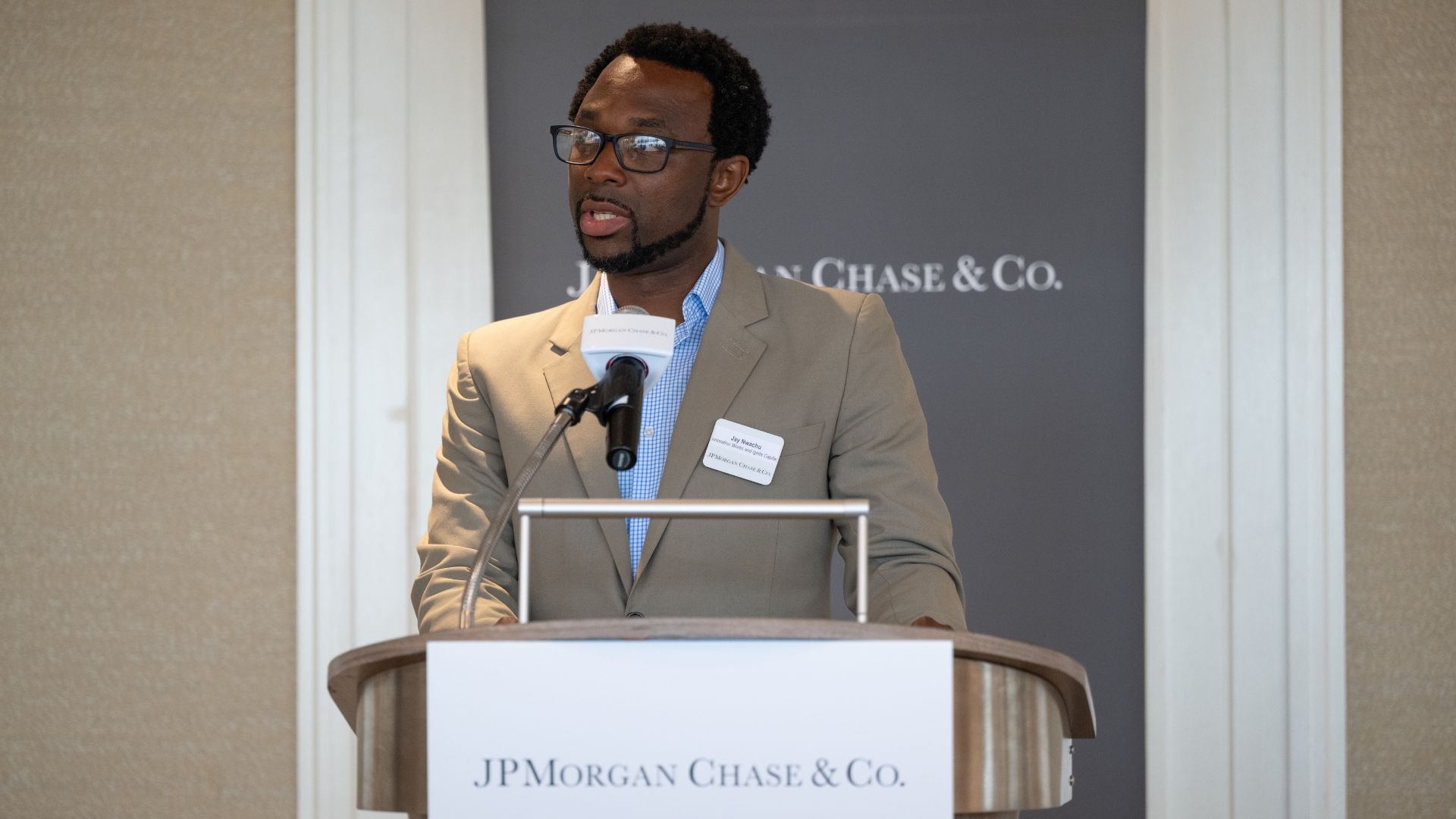
Photo credit: Karanja Gaçuça
Nwachu highlights that their work goes beyond just assisting individual businesses – it is about breathing new life into neighborhoods, creating jobs, driving economic growth, and instilling a sense of community pride.
These intentional and continuing overtures to the underserved and under-invested Black and Latino communities have come about following JPMorgan’s admission of the systemic exclusionary practices within the banking industry. “Systemic racism is a tragic part of America’s history,” JPMorgan Chase CEO Jamie Dimon acknowledged in a statement in 2020. “We can do more and do better to break down systems that have propagated racism and widespread economic inequality.”
In 2020, JPMorgan Chase made a commitment to invest over $30 billion to redress racial inequity across the United States. Since then, JP Morgan has declared that they have not only met but exceeded their $30B goal, announcing that they had already deployed $30.7B as of December 31, 2023.
The commitments and overtures made by JP Morgan Chase are certainly welcome in a city that has historically borne the brunt of the notorious historic practice of redlining, in particular by the bigger Wall Street behemoths such as JPMorgan and other such financial institutions of that caliber.
That said, Baltimore residents would be forgiven for being skeptical about the long-term commitment by banks such as JPMorgan. In speaking with local residents during this and other recent events, there seems to be cautious optimism that the “big banks” may have finally realized that proactively serving all communities is good business. Indeed at a recent event in Washington, D.C., Jamie Dimon, JPMorgan Chase CEO and Chairman responded to The Baltimore Times’ question about diversity initiatives pointing out that “diversity is good for business.”
The firm employs 1,500 people across the region, serves over 1.2 million customers through 110 local branches, and has invested over $147 million since 2019 in affordable housing, small businesses, and philanthropic partnerships.
“This work in West Baltimore with the support of JPMorgan Chase, transforming a neighborhood house by house from what we used to see to what we want to see,” stated Mayor Brandon Scott. He praised the investment for helping “fuel Baltimore’s renaissance.”
Bree Jones, founder of Parity Homes— and a past recipient of JPMorgan Chase’s catalytic housing capital— highlighted the potential for innovative solutions and transformative impact. “Although hyper vacancy represents one of Baltimore’s greatest challenges, it also represents Baltimore’s greatest opportunity,” she said. Her optimistic outlook reframes the obstacles facing Baltimore as openings for positive change when approached strategically.
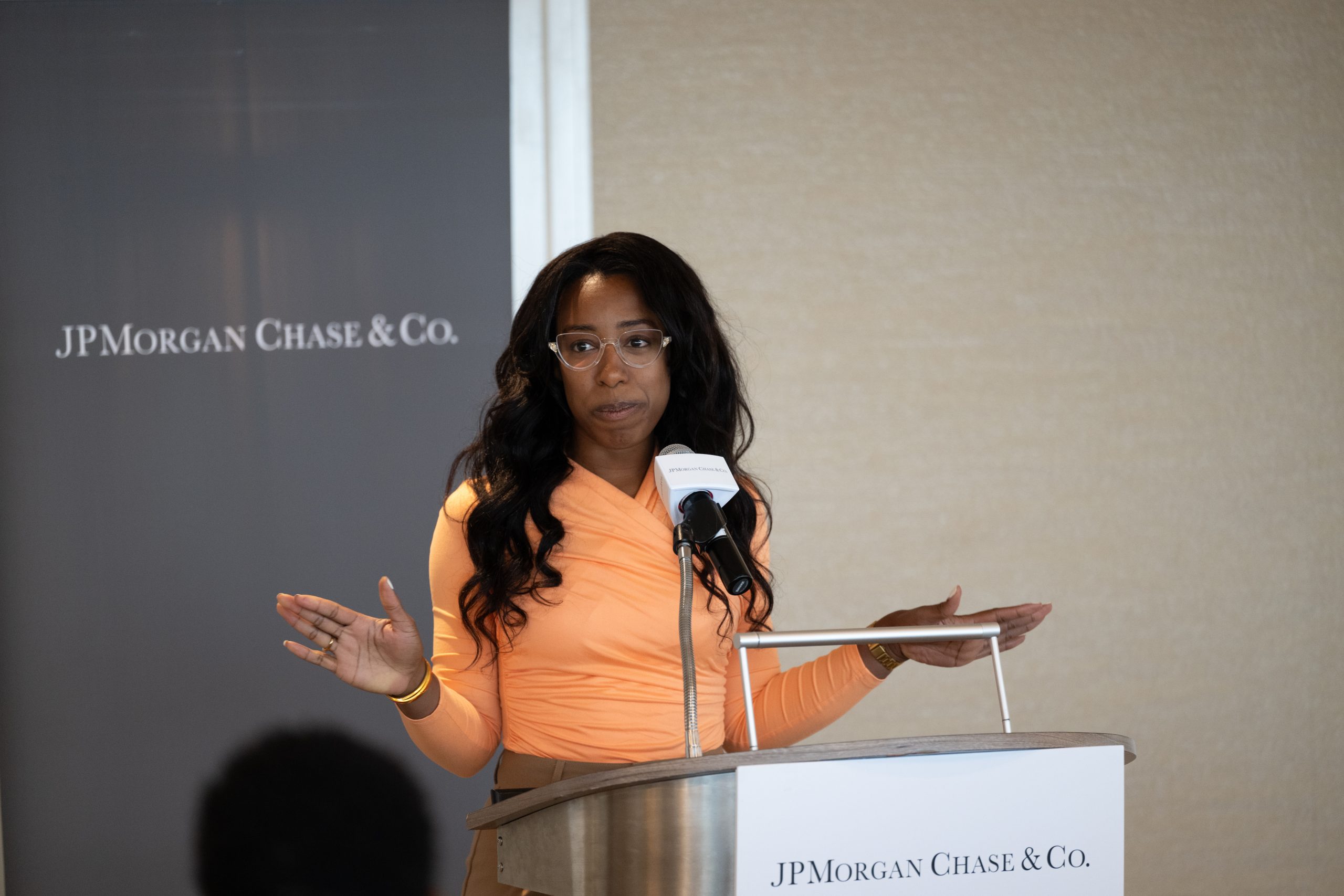
Photo credit: Karanja Gaçuça
JPMorgan Chase prides itself in having called Baltimore home for 130-years and clearly wants to be seen as a key economic anchor and driver of inclusive growth in the city. The bank is aggressively seeking to cement its legacy, deepening its civic ties to Baltimore through its multi-million dollar investments.
Karanja Gaçuça is the Publisher, President/ CEO of The Baltimore Times. A former Wall Street analyst, consultant, journalist and Pan African activist, he writes on issues of global geopolitics as it pertains to people of African descent the world over, as well as politics, economics, finance and tech! Karanja is a tech founder and CEO of Enkaare LLC.