
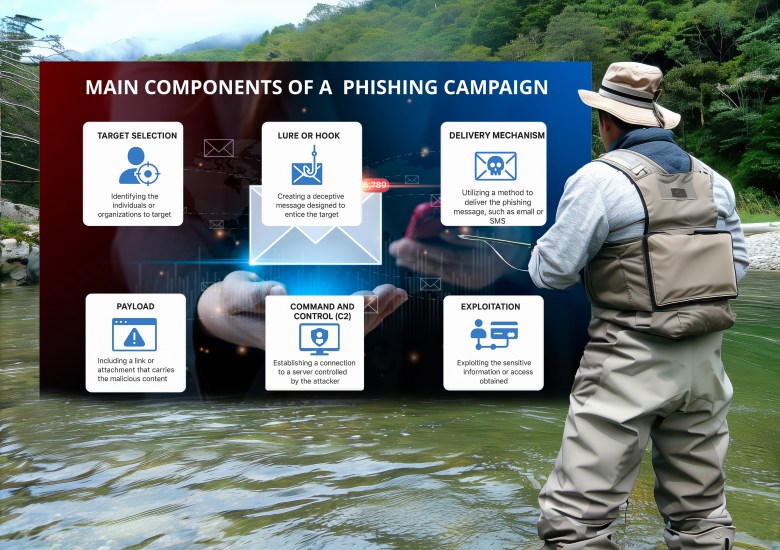
With spring having recently started and April well underway, the mischief of April Fools’ Day serves as a powerful metaphor for understanding the darker world of social engineering and phishing attacks. Just as pranksters manipulate scenarios to fool their targets, cybercriminals use psychological manipulation to bypass established security systems. They do this by exploiting human vulnerabilities given that we generally are the weakest link in any security strategy.
Phishing campaigns succeed by creating convincing illusions that, like April Fools’ pranks, depend on the momentary suspension of disbelief and trust in what we see. The key difference lies in the consequences. While April Fools’ jokes typically end with laughter, phishing attacks lead to compromised accounts, data breaches, and financial losses from which organizations and people spend years recovering. In this series, we will take a deeper dive into the anatomy of a phishing campaign so that you can recognize a phish during your work and home computing.
Anatomy of a Phishing Campaign
A phishing campaign is a social engineering strategy, generally implemented via email, which bad actors use to manipulate you into divulging sensitive information, clicking on malicious links, or performing actions that compromise security. By impersonating trusted entities through deceptive communications, they trick us into becoming the vector of their attack versus technical weaknesses. According to KnowB4, a human risk management company in the cybersecurity space, social engineering and phishing are responsible for 70-90% of all malicious digital breaches.
A phishing campaign typically involves several core components designed to deceive victims (you) and steal sensitive information. This includes:
- Reconnaissance and targeting: Attackers research potential victims, gathering information about organizational structures, relationships, and individual details to make their approaches more convincing and targeted. The approach used can be:
a. Broad-based, targeting random people or a large group of recipients (mass phishing).
b. Targeted at specific individuals or organizations (spear phishing).
c. Targeted at high-profile individuals like executives or government officials (whale phishing). - Infrastructure setup: This includes creating spoofed websites, registering deceptive domain names, establishing email accounts, and deploying technical tools to evade established security measures.
- Lure crafting: Developing compelling messages that create urgency, curiosity, or fear to motivate action. This is generally a message that is designed to grab your attention, often using urgency or fear tactics (e.g., account locked, payment overdue, prize won). Most often it mimics a trusted source like a bank, employer, or service provider using a forged email address or domain.
- Distribution method: The delivery mechanism for the phishing content, commonly email but also including SMS (smishing), voice calls (vishing), social media messages, or even physical approaches.
- Psychological triggers: Employing social engineering tactics like authority (appearing to be from leadership), scarcity (limited time offers), urgency (immediate action required), or familiarity (mimicking known entities).
- Payload or goal: The ultimate objective, which might be credential harvesting, malware deployment, wire transfer fraud, data theft, or establishing persistence in systems. If you click a link, you are taken to a fake website (login page, payment portal, etc.) that harvests your credentials or financial info. In some cases, malware is downloaded onto the device you are using.
- Evasion techniques: Methods to bypass security controls, including HTML obfuscation, image-based emails, legitimate hosting services, and timing attacks during periods of reduced vigilance.
- Data collection mechanisms: The attacker then uses forms, keyloggers, or other mechanisms to capture the valuable information you have unwittingly provided.
- Follow-up actions: Now that the attacker has your information, s/he can use the stolen credentials or data to access other systems or accounts to which you have access, to impersonate you (the victim), and/or steal money or further spread the campaign.
- Many sophisticated campaigns include additional communications to further manipulate you after the initial success.
Understanding these components can help you, your household, and your organization develop more effective defenses against these increasingly sophisticated social engineering attacks. At the end of the day, staying safe from phishing comes down to being alert and trusting your instincts. If something feels off, whether it’s an email, a link, or a strange request, pause and double-check before acting. Being vigilant and attentive lets attackers know that the joke’s on them!

Courtesy, Karen Clay