
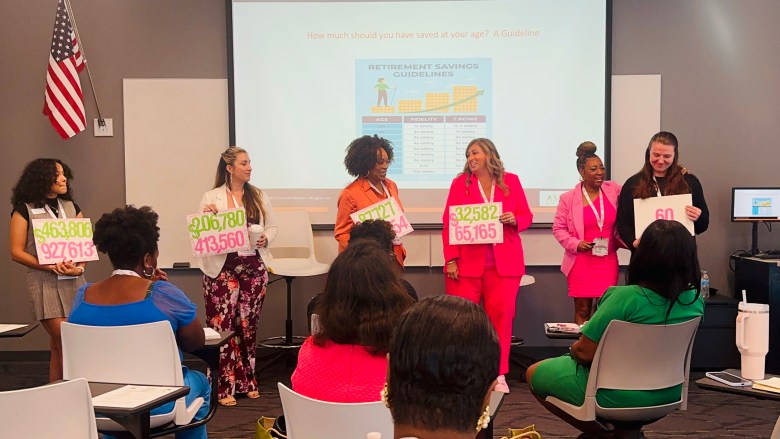
National Financial Literacy Month in April offers an opportunity to think about evaluating finances and increasing one’s financial education. Reshell Smith, CFP® (CERTIFIED FINANCIAL PLANNER™) and owner of AMES Financial Solutions, helps families and individuals create personalized financial strategies to achieve their long-term goals that range from retirement planning and wealth planning to tax strategies.
Smith explained the nuts and bolts of wealth plans and key financial topics. The rich are known to create wealth plans. However, planning long-term financial goals is not only reserved for the rich.
“Wealth plans are for anyone who has financial goals,” said Smith.

She stated that a wealth plan is a comprehensive strategy that outlines how a person will manage, grow, protect, and ultimately disburse their wealth.
“Wealth plans typically include cash flow management, investing, debt reduction strategies, retirement planning, tax strategies and estate planning. The goal of wealth plans is to create a roadmap that aligns with one’s financial aspirations and values,” Smith also said.
She suggested a few ways to build wealth that are less risky and financially feasible for many men or women who want to get started with minimal resources.
Find and read books on finances that are understandable; ensure that you are taking advantage of the options offered by your employer; consider firms or online apps like Robinhood, Webull, Acorn, and Coinbase that let you start investing without a minimum deposit; consider learning about Exchange Traded-Funds (a type of investment fund) and not just how to pick stocks; and seek professional help from a financial professional who can help you understand who you are as an investor.
The CPF agreed that risky investments should be pursued with caution during these tough financial times.
She added, “In this current environment, we have to be strategic about how we move our money around. If someone is considering purchasing a big-ticket item, they need to properly assess their cash flow and future employment. Both of these could change significantly. For day-to-day living, I suggest people revisit, and if necessary, adjust their budgets. The expectation is that prices are going to increase on certain items and the items in the average shopping cart will cost more.”
Smith added that most financial professionals will suggest sticking to long-term goals when it comes to the stock market.
“Historically, investors have added gold to their portfolio as a hedge when the market is trending down. Now, we have digital assets as an option. This is where I would highly encourage investors to take the most caution, mainly due to inexperience and the risky nature of digital assets.”

Individuals can take more responsibility for their own retirement by starting to save money for it early; investing in the stock market; saving as much as they can as often as possible, setting up automatic contributions; and diversifying their investments, according to Smith.
She also provided sound advice for business owners, adding that every business will have its formula for success, but the example Smith mentioned is important.
“I highly encourage small business owners to establish an emergency fund. Just like individuals, business owners need a cushion, and their cushion should be larger because if there is an unexpected business expense, it is likely higher than if an individual ran into an emergency. I suggest that small business owners have a formula for money coming in. For example, 60% goes back into the business and payroll, 30% to taxes and 10% to savings,” Smith explained.
Death and divorce are the two most significant life events that the financial expert often sees impact the lives of her clients, but a major illness is the most common and disruptive. Smith noted that fortunately, medical debt does not blemish your credit as much as it did in the past.
However, lifestyle inflation—increasing your spending when your income increases; delaying when you begin saving; paying high interest and fees; and piling up debt are several common money mistakes.
Smith noted important pieces of bouncing back from making them are “changing your mindset and behaviors.”
“You have to be intentional about meeting your goals,” she wisely advised.
Smith, who is also the author of “A Woman’$ Worth: 7 Key Essentials to Financial Independence,” provides virtual services. Learn more about Smith via www.AMESFinancialSolutions.com and www.ReshellSmith.com.
Disclaimer: The information provided in this article is for general informational purposes only and should not be construed as professional financial advice. We recommend consulting with a qualified financial professional before making any decisions based on the information provided. The author and publisher are not responsible for any errors, omissions, or actions taken based on the information in this article.
- Andrea Blackstone
- Andrea Blackstone
- Andrea Blackstone
- Andrea Blackstone
- Andrea Blackstone
- Andrea Blackstone
- Andrea Blackstone
- Andrea Blackstone
- Andrea Blackstone
- Andrea Blackstone
- Andrea Blackstone
- Andrea Blackstone
- Andrea Blackstone
- Andrea Blackstone
- Andrea Blackstone
- Andrea Blackstone
- Andrea Blackstone
- Andrea Blackstone
- Andrea Blackstone
- Andrea Blackstone
- Andrea Blackstone
- Andrea Blackstone
- Andrea Blackstone
- Andrea Blackstone
- Andrea Blackstone
- Andrea Blackstone
- Andrea Blackstone
- Andrea Blackstone
- Andrea Blackstone
- Andrea Blackstone
- Andrea Blackstone
- Andrea Blackstone
- Andrea Blackstone
- Andrea Blackstone
- Andrea Blackstone
- Andrea Blackstone
- Andrea Blackstone
- Andrea Blackstone
- Andrea Blackstone
- Andrea Blackstone
- Andrea Blackstone
- Andrea Blackstone
- Andrea Blackstone
- Andrea Blackstone
- Andrea Blackstone
- Andrea Blackstone
- Andrea Blackstone
- Andrea Blackstone
- Andrea Blackstone
- Andrea Blackstone
- Andrea Blackstone
- Andrea Blackstone
- Andrea Blackstone
- Andrea Blackstone
- Andrea Blackstone
- Andrea Blackstone
- Andrea Blackstone
- Andrea Blackstone
- Andrea Blackstone
- Andrea Blackstone
- Andrea Blackstone
- Andrea Blackstone
- Andrea Blackstone
- Andrea Blackstone
- Andrea Blackstone
- Andrea Blackstone
- Andrea Blackstone
- Andrea Blackstone
- Andrea Blackstone
- Andrea Blackstone
- Andrea Blackstone
- Andrea Blackstone
- Andrea Blackstone
- Andrea Blackstone
- Andrea Blackstone
- Andrea Blackstone
- Andrea Blackstone
- Andrea Blackstone
- Andrea Blackstone
- Andrea Blackstone
- Andrea Blackstone
- Andrea Blackstone
- Andrea Blackstone
- Andrea Blackstone
- Andrea Blackstone
- Andrea Blackstone
- Andrea Blackstone
- Andrea Blackstone
- Andrea Blackstone
- Andrea Blackstone
- Andrea Blackstone
- Andrea Blackstone
- Andrea Blackstone
- Andrea Blackstone
- Andrea Blackstone
- Andrea Blackstone
- Andrea Blackstone
- Andrea Blackstone
- Andrea Blackstone
- Andrea Blackstone
- Andrea Blackstone
- Andrea Blackstone
- Andrea Blackstone
- Andrea Blackstone
- Andrea Blackstone
- Andrea Blackstone
- Andrea Blackstone
- Andrea Blackstone
- Andrea Blackstone
- Andrea Blackstone
- Andrea Blackstone
- Andrea Blackstone
- Andrea Blackstone
- Andrea Blackstone
- Andrea Blackstone
- Andrea Blackstone
- Andrea Blackstone
- Andrea Blackstone
- Andrea Blackstone
- Andrea Blackstone
- Andrea Blackstone
- Andrea Blackstone
- Andrea Blackstone
- Andrea Blackstone
- Andrea Blackstone
- Andrea Blackstone
- Andrea Blackstone
- Andrea Blackstone
- Andrea Blackstone
- Andrea Blackstone
- Andrea Blackstone
- Andrea Blackstone
- Andrea Blackstone
- Andrea Blackstone
- Andrea Blackstone
- Andrea Blackstone
- Andrea Blackstone
- Andrea Blackstone
- Andrea Blackstone
- Andrea Blackstone
- Andrea Blackstone
- Andrea Blackstone
- Andrea Blackstone
- Andrea Blackstone
- Andrea Blackstone
- Andrea Blackstone
- Andrea Blackstone
- Andrea Blackstone
- Andrea Blackstone
- Andrea Blackstone
- Andrea Blackstone
- Andrea Blackstone
- Andrea Blackstone
- Andrea Blackstone
- Andrea Blackstone
- Andrea Blackstone
- Andrea Blackstone
- Andrea Blackstone
- Andrea Blackstone
- Andrea Blackstone
- Andrea Blackstone
- Andrea Blackstone
- Andrea Blackstone
- Andrea Blackstone
- Andrea Blackstone
- Andrea Blackstone
- Andrea Blackstone
- Andrea Blackstone
- Andrea Blackstone
- Andrea Blackstone
- Andrea Blackstone
- Andrea Blackstone
- Andrea Blackstone
- Andrea Blackstone
- Andrea Blackstone
- Andrea Blackstone
- Andrea Blackstone
- Andrea Blackstone
- Andrea Blackstone
- Andrea Blackstone
- Andrea Blackstone
- Andrea Blackstone
- Andrea Blackstone
- Andrea Blackstone
- Andrea Blackstone
- Andrea Blackstone
- Andrea Blackstone
- Andrea Blackstone
- Andrea Blackstone
- Andrea Blackstone
- Andrea Blackstone
- Andrea Blackstone
- Andrea Blackstone
- Andrea Blackstone
- Andrea Blackstone
- Andrea Blackstone
- Andrea Blackstone
- Andrea Blackstone
- Andrea Blackstone
- Andrea Blackstone
- Andrea Blackstone
- Andrea Blackstone
- Andrea Blackstone
- Andrea Blackstone
- Andrea Blackstone
- Andrea Blackstone
- Andrea Blackstone
- Andrea Blackstone
- Andrea Blackstone
- Andrea Blackstone
- Andrea Blackstone
- Andrea Blackstone
- Andrea Blackstone
- Andrea Blackstone
- Andrea Blackstone
- Andrea Blackstone
- Andrea Blackstone
- Andrea Blackstone
- Andrea Blackstone
- Andrea Blackstone
- Andrea Blackstone
- Andrea Blackstone
- Andrea Blackstone
- Andrea Blackstone
- Andrea Blackstone
- Andrea Blackstone
- Andrea Blackstone
- Andrea Blackstone
- Andrea Blackstone
- Andrea Blackstone
- Andrea Blackstone
- Andrea Blackstone
- Andrea Blackstone
- Andrea Blackstone
- Andrea Blackstone
- Andrea Blackstone
- Andrea Blackstone
- Andrea Blackstone
- Andrea Blackstone
- Andrea Blackstone
- Andrea Blackstone
- Andrea Blackstone
- Andrea Blackstone
- Andrea Blackstone
- Andrea Blackstone
- Andrea Blackstone
- Andrea Blackstone
- Andrea Blackstone
- Andrea Blackstone
- Andrea Blackstone
- Andrea Blackstone
- Andrea Blackstone
- Andrea Blackstone
- Andrea Blackstone
- Andrea Blackstone
- Andrea Blackstone
- Andrea Blackstone
- Andrea Blackstone
- Andrea Blackstone
- Andrea Blackstone
- Andrea Blackstone
- Andrea Blackstone
- Andrea Blackstone
- Andrea Blackstone
- Andrea Blackstone
- Andrea Blackstone
- Andrea Blackstone
- Andrea Blackstone
- Andrea Blackstone
- Andrea Blackstone
- Andrea Blackstone
- Andrea Blackstone
- Andrea Blackstone
- Andrea Blackstone
- Andrea Blackstone
- Andrea Blackstone
- Andrea Blackstone
- Andrea Blackstone